
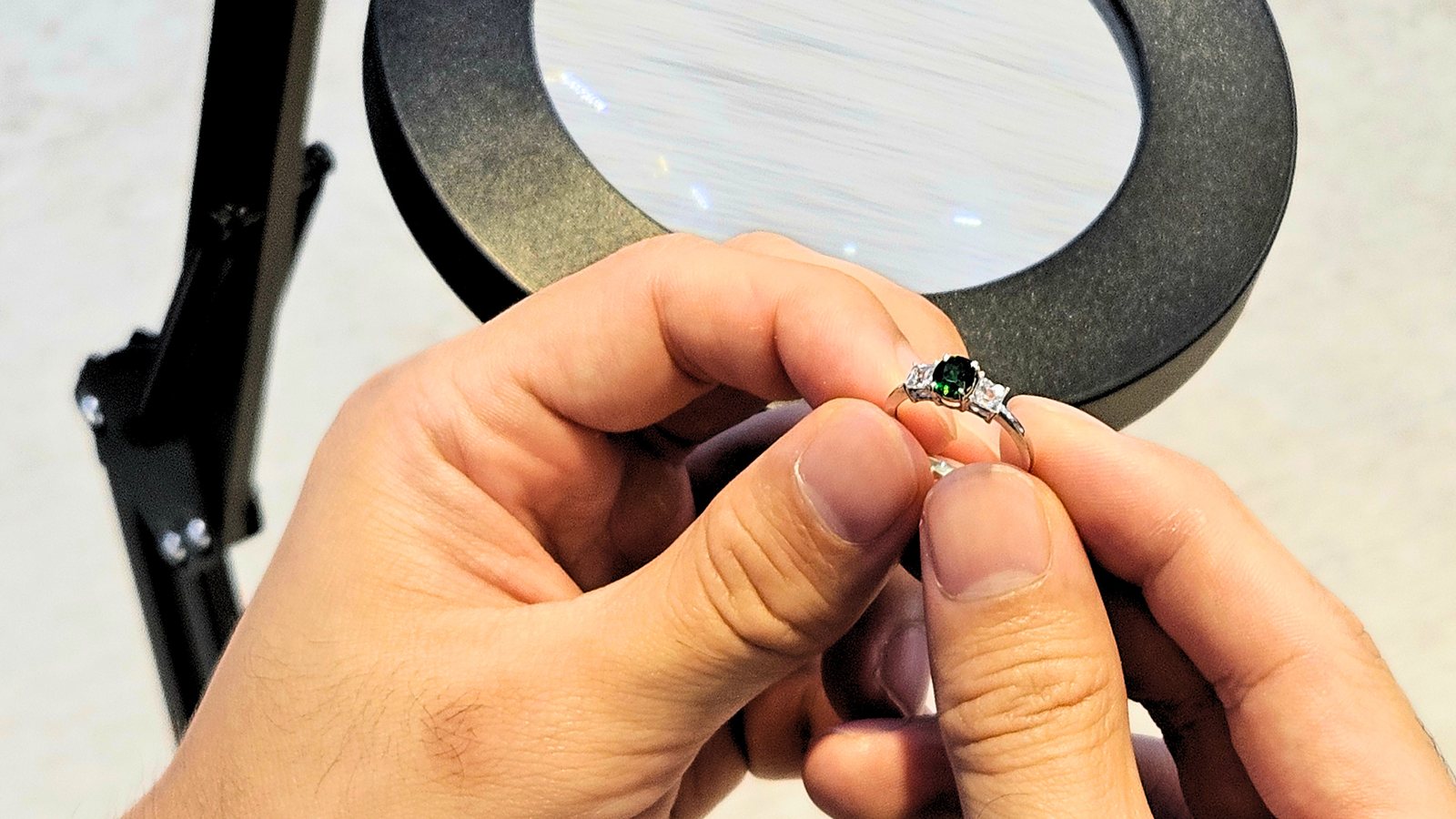
Jewellery that is worn and loved will, sooner or later, show it. Claws flatten, bands thin, stones pick up small chips, and a sapphire that once caught every bit of light can start to look tired. None of this means the piece was badly made. It is simply the mark of something that has been part of someone’s life.
The good news is that most of it can be put right. With the right care, a ring worn every day for thirty years can look and feel close to new, and a piece that has been sitting in a family drawer can be made ready for whoever wears it next. Here is an overview of what is possible, and how to tell when a piece is due for some attention.
Signs your jewellery needs a check
Most problems start small and are far easier to put right early, before they turn into a lost stone. It is worth taking a closer look if you notice any of the following.
- The stone moves, or makes a faint click when you tap the ring gently near your ear.
- The claws look flat, thin or uneven, or they keep catching on clothing and hair.
- The stone sits higher or lower than it used to, or looks slightly tilted.
- The band has become thin at the bottom, or has lost its round shape.
- Small stones are missing from a halo, a pavé row or an eternity band.
- A clasp no longer closes firmly, or a chain has a stretched or weakened link.
- White gold looks yellowish in patches.
- The gemstone looks dull even after a proper clean, or you can see chips along its edge.
As a general habit, having everyday rings checked once a year is a good way to catch small issues before they become expensive ones. It takes a few minutes, and it has saved a great many stones from disappearing down a drain.
Common jewellery repairs
Retipping and rebuilding claws. Claws, sometimes called prongs, do all the work of holding a stone in place, so they wear faster than anything else on a ring. When they become thin, new metal can be added to the tips, or the claws can be rebuilt entirely if they are too far gone. For a ring worn every day, this is the single most important piece of maintenance there is.
Tightening loose stones. A loose stone can usually be secured by carefully adjusting the claws or the metal rim around it. If the setting itself has worn down, it needs to be rebuilt first, so the stone has something solid to sit in.
Resizing. Most rings can be made larger or smaller by adding or removing a small section of the band. Some designs are more difficult, particularly eternity rings with stones set all the way round, and occasionally the honest answer is that the ring would need to be remade.
Reshanking. When the bottom of a band has worn very thin, the lower section can be replaced with new metal while the original top of the ring is kept exactly as it is. It is a good way to keep a much loved ring going for many more years.
Replacing missing stones. Small diamonds or coloured stones that have fallen out of a setting can be matched as closely as possible for size and colour, then reset.
Chains, clasps and earring fittings. Broken links, weak clasps and worn earring posts are usually quick repairs, and well worth doing before a piece is lost altogether.
Rhodium replating. White gold is naturally a pale, slightly warm colour, and most white gold jewellery is plated with rhodium to give it that bright white finish. The plating wears away with time, which is why white gold can start to look yellowish in places. Replating restores the original colour, and for a ring worn daily it is normal to need this every year or two.
Cleaning and polishing. A professional clean and polish lifts away the build up of soap, lotion and everyday grime, along with the fine scratches in the metal. It often makes far more difference than people expect.
A note on 916 gold
Many Malaysian families have jewellery made in 916 gold, which is 22 karat. It has a lovely deep colour, but it is softer than 18 karat gold, so claws and thin settings wear down more quickly. When repairing or rebuilding a setting on a 916 piece that holds a precious stone, it is worth discussing whether the claws should be strengthened or rebuilt in a harder alloy, so the stone stays secure.
When the gemstone itself needs attention
Metal is not the only thing that wears. Even sapphire, which is very hard, can be chipped or scuffed after years of knocks against tables, door handles and car keys. The damage usually shows around the girdle, which is the outer edge of the stone, and along the sharp lines where the facets meet.
Repolishing. For stones with light surface wear or small chips, a careful repolish restores the brightness while removing only a tiny amount of material. This is often the ideal choice for inherited stones, because it freshens them without changing their character.
Recutting. For stones with deeper chips, or stones that were never cut well in the first place, a full recut may be worthwhile. It means giving up some weight in exchange for better brightness and more even colour. Because gemstones are valued far more on how they look than on what they weigh, a stone that looks clearly better after a recut can be worth more than it was, even though it is lighter.
Whether a stone should be repolished, recut or left exactly as it is depends on its condition, on what sits inside it, and on what matters most to you. It is always a conversation. Nothing is done to a stone without your say.
Why some stones must be removed before repair
Many repairs, such as retipping claws or resizing a band, involve heat from a jeweller’s torch. Some gemstones do not cope well with that heat, so they are taken out before the work begins and set back in afterwards. These include:
- Emerald, which is commonly treated with oil or resin that heat can affect.
- Opal, pearl, turquoise and coral, all of which are sensitive to heat and to chemicals.
- Glass filled ruby and other fracture filled stones, where the filling itself can be damaged.
- Tanzanite and a few others that can crack if the temperature changes too suddenly.
This is one good reason to know exactly what stone is in a piece before it goes to the bench. If you are not sure, having the stone checked beforehand avoids any unpleasant surprises.
What to expect when you bring a piece in
Assessment. The piece is examined under magnification to check the setting, the metal and the stone. Any existing damage is noted before anything is touched.
Recommendation and quote. You will be told what we recommend, what is optional, and what it will cost. If a repair is not worth doing, or if remaking the piece would make better sense, we will say so.
The work itself. Stones are removed where they need to be, the repair is carried out, and the piece is cleaned and polished.
Collection. You can look over the finished piece, check the fit, and ask anything you like about caring for it.
Most repairs take roughly one to two weeks, depending on the extent of the work needed.
Repair or redesign?
Every so often a piece has worn to the point where a repair is possible but a redesign would serve it better. Sometimes the owner simply wants something that suits the way they dress today. Precious stones can almost always be lifted from an old setting and given a new one, so the part that carries the meaning stays. You may well decide to keep the original, and that is perfectly fine. It is just worth knowing the option is there.
Looking after your jewellery between visits
- Take rings off for heavy work, gym sessions, gardening and swimming.
- Store pieces separately, so harder stones do not scratch softer ones.
- Clean at home with warm water, a little mild soap and a soft brush. Delicate stones such as emerald, opal and pearl are better wiped gently with a soft cloth.
- Glance at your rings from time to time. If a claw looks thin or a stone seems to move, bring it in sooner rather than later.
If you have a piece that needs some care, whether it is a ring you wear every day or something from the family that has been tucked away in a drawer, you are very welcome to bring it to our gallery at Publika. We are happy to take a look and tell you what we would suggest.